Why Children and Adults Freeze in Learning
Fear, Avoidance & Growth Mindset in Dance Classes
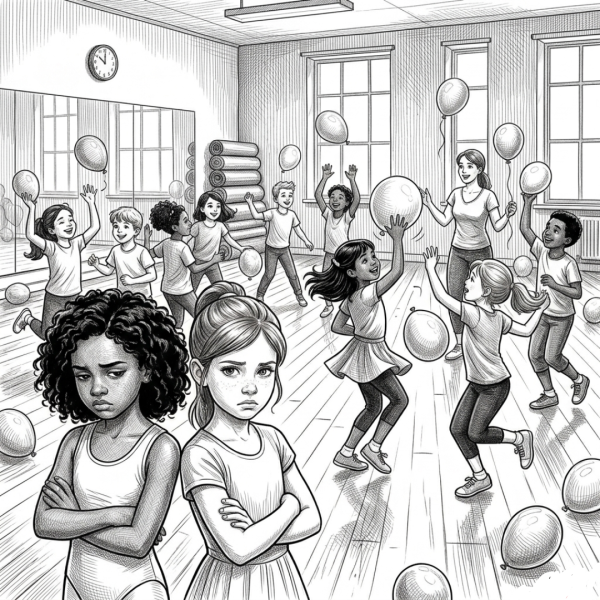
In early childhood dance classes, you see every type of learner: the fearless jumpers, the quiet observers, and those who—before even attempting a single movement—announce loudly, “I can’t do it.” What’s fascinating is that the same pattern appears in adult classes. One or two participants freeze the moment a new movement is introduced, even though the teacher has just demonstrated it and the whole point is to practice together.
This isn’t just a dance-class issue. It’s a psychological pattern that shows up in playgrounds, classrooms, workplaces, and creative hobbies.
Take this example: A little girl in kindergarten never participates in the tag games outside. Because she is not a fast runner, she stays outside the game every time. Even when her peers—some of whom were also slow at first—improve their speed and agility simply by trying and running at every opportunity, her abilities remain the same. She never joins, so she never gets the chance to grow. Over time, she begins to shut herself off from more and more activities. She becomes angry when the whole group is having fun, and jealous when others acquire skills she lacks. What started as avoiding one game slowly spreads into dancing, playing, and every new learning opportunity.
Why does this happen? Why do some people leap into new experiences while others shut down before they even begin? And importantly: is it even worth addressing this if you only have a short workshop, a single class, or a brief encounter with the learner? What should you do when someone has already declared loudly, “I can’t”?
This post explores the psychology behind this phenomenon and discusses practical ways to support learners—both children and adults—when they hit this emotional wall. And it’s important to say this out loud: teachers also need peace of mind. If a child has a long history of avoiding every challenge, like the kindergarten girl who refuses tag, dance, and group play, it may not be possible to “fix” the pattern in a single class or short workshop.
A teacher can offer safety, encouragement, and opportunities, but when avoidance has become a deeply rooted coping strategy, the issue goes far beyond one dance lesson. In these cases, the child needs long-term support, consistent guidance, and sometimes professional help. The responsibility does not fall on the shoulders of one instructor in one moment.
Recognizing this frees teachers from unrealistic expectations. You can still make a positive impact—by planting a seed, offering a safe experience, or giving the child one small success—but you don’t have to perform miracles. Some learners carry emotional patterns that require time, repetition, and a supportive environment across many contexts.
The Psychology Behind the Freeze Response
When a child or adult refuses to try something new, the behavior is rarely about the task itself. It is almost always about emotional safety. The brain is wired to avoid situations that feel threatening, and for many people, trying something new in front of others feels exactly like that. When the nervous system senses danger, it triggers one of three responses: fight, flight, or freeze.
Freeze looks like this: standing still, refusing to try, shutting down, or saying “I can’t” before even attempting. This is not defiance. It is a protective reflex.
Fear of shame is one of the most powerful social emotions. Even very young children can feel it. The thought “What if others see me fail?” activates neural circuits similar to those involved in physical pain. To avoid that pain, the person avoids the activity. If a child repeatedly avoids a challenge, the avoidance becomes a habit. The brain learns:
- “Avoiding keeps me safe.”
- “Trying feels dangerous.”
This is exactly what happens with the kindergarten girl who never joins tag. Her avoidance becomes a self-reinforcing loop: She doesn’t try → she doesn’t improve → she feels even more behind → she avoids even more. Over time, this avoidance spreads into other areas: dance, games, group activities, even learning itself.
Add to this the power of social comparison. Children and adults constantly compare themselves to others. When they see peers improving faster, they may feel jealousy, frustration, hopelessness, or anger. These emotions push them further into avoidance and can turn into a form of identity protection:
- “If I don’t try, no one can judge me.”
- “If I fail without trying, it doesn’t count.”
Carol Dweck’s research on mindset shows that people with a fixed mindset believe abilities are innate:
- “I’m not a runner.”
- “I’m not flexible.”
- “I’m not coordinated.”
So they avoid situations that might prove them “not good enough.” People with a growth mindset, on the other hand, believe abilities can improve with practice. They try, fail, try again—and grow.
Practical Strategies for Teachers and Instructors
Even in a short workshop or single class, you can create a moment of safety, curiosity, or success that stays with the learner. You may not change a lifelong pattern, but you can influence how the learner feels in that moment—and sometimes that is enough to plant a seed.
Below is a clear chart with three sections: Acknowledgment, for Children, for Adults.
| Category | Strategy Phrases |
|---|---|
| Acknowledgment | “Thanks for telling me. Many people feel this way at first.” |
| “You don’t need to get it right — we’re just exploring.” | |
| “It’s completely okay to feel unsure with something new.” | |
| “Let’s try just the first part together.” | |
| “That was a great try.” | |
| “Don’t worry about how it looks — focus on how it feels.” | |
| Children | “You can watch first and join when you’re ready.” |
| “Can you lift your arm? Perfect — that’s already dancing.” | |
| “Let’s pretend we’re animals moving through the forest.” | |
| (Quietly) “I’ll help you. Let’s try it together.” | |
| “Oops, I made a mistake too — let’s try again.” | |
| “You can join when you feel comfortable.” | |
| Adults | “No one is expected to know this yet.” |
| “Let’s focus on just this one movement first.” | |
| “Everyone learns at their own pace.” | |
| “Feel the movement — don’t worry about perfection.” | |
| “If we all look a bit silly, we’re doing it right.” | |
| “Let’s experiment with this and see what happens.” |
Different Learners, Different Needs
Especially in kindergarten groups, there are always one or two very dominant, very brave, sometimes even “aggressive” children. These are often the kids who challenge teachers the most — the ones who may frighten their peers, disrupt routines, or push boundaries. And yet, in my experience working in kindergartens for two years, these children are often the most sensitive learners of all.
Before each new group or class, teachers usually share how the children’s day has been — whether they were emotionally exhausted, kiukkuiset (irritable), overstimulated, or calm. When it’s a brand‑new group, teachers also point out which children are considered “problematic.” And here is the surprising pattern: These so‑called “problematic” children often become the most passive participants in creative dance.
They sit and watch the entire class. Sometimes they join one exercise in the middle, then quickly run back to their place before the next activity begins. And that is completely fine.
What’s fascinating is that almost all of them join the calm, structured final section of the class.
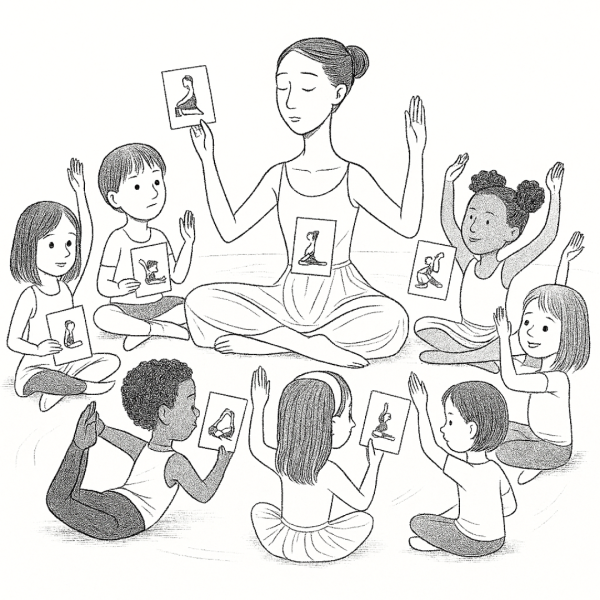
I use printed kids’ yoga cards, soft classical music, and a simple routine: the whole group sits in a circle, each child chooses a card, shows it to the group, demonstrates the pose, and the rest follow.
This combination — visual, slow, predictable, and grounded — has a remarkable effect on even the most reactive or avoidant children. In this moment, they feel safe enough to participate. They feel part of the group. They explore, contribute, and enjoy the shared experience of learning.
This tells us something important: Some children need calmer, more structured, less expressive entry points into creative movement. And there is enormous value in offering these options.
Three Types of Learners in Creative Dance
After observing many groups, I’ve noticed three consistent learner types:
1. The Immediate Participants
These children jump in from the very first lesson. They explore, try, fail, laugh, and try again. They thrive in open, creative environments.
2. The Slow Warm‑Ups
They spend the first few weeks observing. They watch every detail, learn the patterns, and only when they feel safe do they begin to participate fully — eventually becoming just like the first group.
3. The Selective Participants
These children never join the entire class. But they choose one or two exercises they feel comfortable with — often the calmer, more structured ones. They participate in their own rhythm, in their own way.
This is why giving children space to rest, observe, and join when they are ready is one of the most important tools in creative dance. Creative dance uniquely allows this flexibility — and for many children, it is the only way they can participate at all.
The power of one safe moment
The “I can’t, so I won’t even try” response is not laziness, stubbornness, or defiance. It is a deeply human reaction rooted in emotional safety, fear of shame, and years of learned avoidance. Some learners freeze because their nervous system is protecting them. Others avoid because comparison, past experiences, or fixed beliefs about their abilities have shaped their identity.
And while teachers, instructors, and workshop leaders can create supportive environments, it’s important to recognize the limits of what can be changed in a single session.
Some learners—especially those with long histories of avoidance—need consistent support, repeated exposure, long‑term guidance, and sometimes professional help.
Dear teachers: you cannot undo years of emotional patterns in one class. Your job is not to “cure” the child or adult. Your role is to offer:
- safety
- encouragement
- a chance to try
- a positive experience
Even one small moment of success can plant a seed that grows later. Sometimes that seed is the beginning of a new mindset, a new sense of courage, or a new relationship with learning. And even if you never see the final result, your influence matters.
When we create spaces where trying is safe, mistakes are normal, and curiosity is welcomed, we give learners something far more valuable than a single skill. We give them the confidence to take their next brave step—whether in dance, in play, or in life.
Sources
- Dweck, C. (2006). Mindset: The New Psychology of Success.
- Yeager, D. & Dweck, C. (2012). “Mindsets That Promote Resilience.” Educational Psychologist
- Brown, B. (2012). Daring Greatly.
- Tangney, J. & Dearing, R. (2002). Shame and Guilt.
- Clark, D. & Beck, A. (2010). Cognitive Therapy of Anxiety Disorders.
- American Psychological Association (APA): articles on avoidance behavior and anxiety.
- Porges, S. (2011). The Polyvagal Theory.
- van der Kolk, B. (2014). The Body Keeps the Score.
- Thomas, A. & Chess, S. (1977). Temperament and Development.
- Center on the Developing Child, Harvard University (online resources).
- Deci, E. & Ryan, R. (2000). “Self-Determination Theory.” American Psychologist.