One of my very first classes in an international elementary school remains one of the most memorable experiences of my teaching career.
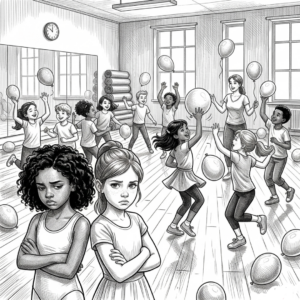
Two groups had been combined into a single session, creating a lively class of approximately forty children supported by six adults in the school’s largest gym. I had prepared a creative dance program that had already been tested successfully many times before. The activities were engaging, the children were enthusiastic, and the atmosphere was full of laughter and excitement.
Everything seemed to be going smoothly.
Next assignment was about rhythm. The children were asked to walk in rhythm, count their steps, move forward for eight counts, gently lie down, and then stand up again. It was a task focused on coordination, rhythm, and counting rather than dance technique.
Then I played a song from the Madagascar movie, I Like to Move It, and introduced a simple exercise.
As I looked around the room, I noticed several small groups of children sitting quietly near the walls.
At first, I assumed they were simply tired. My classes always allow children to take a break whenever they need one. However, one of the school teachers approached me and explained that for some children, their religious beliefs might prohibit dancing or participation in certain types of music.
A Surprising Discovery
My classes typically include a wide variety of music, and I had never considered that a song from a children’s animated movie might become a source of discomfort. After the class, I researched the film and realized that Madagascar was originally intended for children aged seven and older.
The exercise itself seemed completely innocent. The children were not being asked to perform expressive dance movements. They were simply walking, counting, lying down, and standing up in rhythm.
Believing that the activity was essentially a counting exercise, I approached the children and explained that it was only about counting and movement.
They responded politely and calmly.
“That music is not good.”
There was no rebellion, no conflict, and no disruption. They simply chose not to participate during that particular activity.
What struck me most was that as soon as the exercise ended, all of those children rejoined the class and participated enthusiastically in every activity that followed.
More than obedience: A Conscious Choice
Adults often assume that children act impulsively and that self-control develops only later in life. Yet these children demonstrated something quite remarkable. They were not responding to an immediate physical danger or discomfort. Instead, they were responding to an internal system of values.
Whether those values came from religion, family traditions, cultural norms, or personal conviction, the children had already developed an awareness of what they considered acceptable and unacceptable.
They were making conscious choices.
In many ways, this reflected a form of emotional intelligence that is rarely discussed. Emotional intelligence is often described as the ability to recognize emotions and interact effectively with others. However, it can also involve recognizing one’s own boundaries and acting consistently with deeply held beliefs, even when everyone else is doing something different.
Different Inner Worlds in the Same Classroom
Contrast within the room was fascinating.
Most of the children were dancing, laughing, and completely immersed in the playful atmosphere. They experienced the music as fun, harmless, and exciting.
At the same time, a small group of children was engaged in a very different internal process.
While the others were focused on movement and play, these children appeared to be considering questions of permission, values, and responsibility. They were not merely following instructions. They were evaluating whether participation aligned with what they had been taught.
Looking at the same activity, different children saw different realities.
The exercise had not changed. The music had not changed.
Yet their experiences were profoundly different.
what shapes human behavior?
That moment reminded me how strongly education, culture, religion, and family traditions shape a person’s inner world.
When we compare ourselves with others, these differences can sometimes appear dramatic. We may assume that everyone experiences a situation in roughly the same way. In reality, each individual interprets the world through a unique combination of beliefs, values, memories, and social influences.
What appears to be a simple dance exercise to one child may carry a completely different meaning for another.
As teachers, educators, and leaders, we do not always need to agree with every perspective we encounter. But experiences like this remind us of the importance of curiosity, sensitivity, and respect.
Dance, Values, and Cultural Sensitivity
Perhaps the most practical lesson I learned from this experience was the importance of being much more selective with music choices, even when working with music from children’s films or other seemingly harmless sources.
Something that appears innocent and enjoyable to one child may carry a completely different meaning for another because of their cultural, religious, or family background. As educators, we cannot assume that every piece of music will be perceived in the same way. The same consideration applies to movement choices and dance styles. This experience reminded me that students enter the classroom carrying different values, expectations, and understandings of what is appropriate.
Being culturally sensitive does not mean avoiding dance. Rather, it means recognizing that dance can be experienced and interpreted through many different lenses.
Can Dance Remain Accessible to Everyone?
This experience also made me reflect on how differently people relate to dance itself. Some communities embrace all forms of dance, while others draw clear boundaries regarding what kinds of movement they consider acceptable.
Many people who hold such values would never choose to participate in dance forms they perceive as overly sensual or in conflict with their beliefs. This does not mean that they reject movement, creativity, or artistic expression. Instead, they may have a different vision of what dance should represent.
If public perceptions of dance become dominated by only a narrow selection of contemporary styles, some people may begin to see dance itself as inappropriate or inaccessible. In the process, they may overlook the enormous diversity that exists within the dance world.
Dance is much larger than current trends. It includes folk dances, traditional dances, social dances, circle dances, community dances, ceremonial dances, historical dances, and countless other forms that have brought people together for generations.
Dance as Bodily Expression Rather Than Sexualization
At its core, dance is one of humanity’s most natural forms of bodily expression. Long before it was performed on stages or shared on social media, dance was a way of celebrating, communicating, learning, grieving, connecting, and expressing joy.
Dance can be playful, artistic, athletic, spiritual, meditative, therapeutic, social, and educational. It can help children develop coordination, confidence, creativity, self-awareness, and emotional expression. It can provide a healthy relationship with the body and create opportunities for meaningful connection with others.
When dance is viewed primarily through a sexualized lens, many people may fail to recognize its broader value. Dance should remain a space where individuals can explore movement in a way that aligns with their own conscience, culture, and understanding of self-expression.
Final Reflections on Teaching and Awareness
Looking back, I realize that the children who chose not to participate in that particular exercise gave me an unexpected gift.
They reminded me that teaching dance is not only about movement and music. It is also about awareness, observation, and respect. Every child enters the classroom carrying an invisible inner world shaped by family, education, culture, religion, and personal experience.
That day, I learned that even very young children can possess a surprisingly developed conscience. While some children were completely absorbed in the joy of movement, others were actively reflecting on questions of acceptability, values, and personal responsibility.
Neither group was wrong. They were simply experiencing the same situation through different inner worlds.
As a dance educator, the experience encouraged me to think more carefully about the music I choose, the movements I teach, and the assumptions I make about what dance means to others.
Most importantly, it reminded me that dance has the potential to belong to everyone, but only if we remain aware that not everyone arrives at dance from the same place.