Why Tuija Lehtinen’s Rebekka Is a Masterpiece of Young Adult Fiction
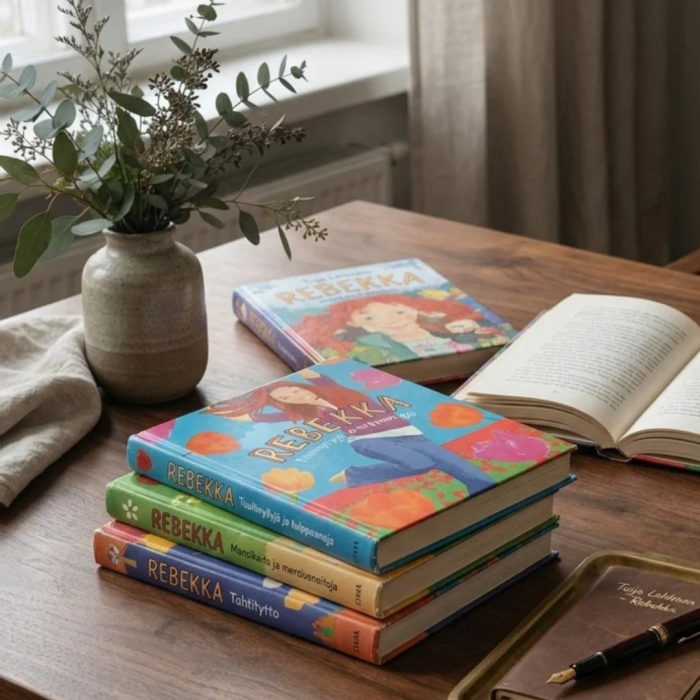
Sometimes the best literary discoveries happen completely by chance—buried in a pile of books at a massive book sale. That is exactly how the first installment of Finnish author Tuija Lehtinen’s eight-book ‘Rebekka’ series ended up in my hands. What began as light reading turned into a true feast for the mind and soul: all eight volumes are devoured in a single breath. Beneath the apparent simplicity of a coming-of-age story lies the brilliant, witty, deeply psychological prose of a writer with a capital W, brimming with subtle humor.
In Dialogue with the Classics: From 'Pride and Prejudice' to the Poetry of the Everyday
Reading ‘Rebekka,’ you can’t help but notice that the book enters into a fascinating dialogue with world classics. In its elegant, proper, and subtly ironic courtship banter, one catches the spirit of Jane Austen. In the way the heroine matures, studies, and falls in love for the first time while discovering new facets of herself, there is a clear echo of Charlotte Brontë’s ‘Jane Eyre.’ And with her rich, vivid imagination, loyal friends, and passion for creativity—even if Rebekka doesn’t write poetry, she wholeheartedly stages improvised plays—she feels remarkably close to ‘Anne of Green Gables.’
Yet Tuija Lehtinen takes a step forward where the classics left off, showcasing a distinctly Finnish reverence for arki—the ordinary, everyday routine. She fills the story with a dense, vibrant, ‘delicious’ sense of daily life. What remained off-stage in older novels becomes the very fabric of the narrative here. Lehtinen poeticizes routine: school lunches, cycling in any weather, family dinners, holiday preparations, Finnish school life, sports, friendships, hikes, the changing of the seasons, and small domestic details. She shows that happiness isn’t waiting for the characters somewhere in the distant future, as in fairy tales—it happens right now, in these imperfect yet vibrant everyday moments.
The Joy of Austen and Brontë: A Triumph of a Free World
Still, the most poignant feeling arises when you mentally transport Jane Austen and Charlotte Brontë themselves into Rebekka’s world. What joy and deep peace of mind those writers would have felt if they could only have glimpsed modern Finland and seen how many opportunities have opened up for young women!
In the 19th century, financial status and dowries dictated a woman’s fate, forcing a choice between humiliating dependence and a marriage of convenience. Lehtinen, by contrast, portrays a society where social mobility is no longer rigidly tied to the thickness of one’s parents’ wallet. Yes, the author honestly—and deliberately gently—depicts differences in wealth: beside Rebekka is her friend from a family of doctors, who has more new outfits, books, travels, and material comforts. Yet in what matters most, they are equals: both attend the same school, both have access to knowledge, sports, and the arts, and both can choose their professions and freely shape their own destinies. Rebekka carries none of the ‘poor relation’ complex that weighed so heavily on the heroines of Brontë and Austen.
Though not wealthy, Rebekka is deprived of nothing: the same paths lie open before her, along with the freedom to choose her own way without fear of public condemnation. Nineteenth-century heroines had to fight simply for the right to exist and earn their daily bread. Rebekka is free from that struggle, so her energy goes elsewhere—into creativity, friendship, exploring the world, understanding human psychology, and searching for her calling. This is a living answer to the question of why a society of equal opportunity was built in the first place. Imagining Jane Austen with her sharp irony and Charlotte Brontë with her thirst for justice looking at a fifteen-year-old Finnish girl—who decides for herself who she wants to be, falls in love freely without fearing for her ‘reputation,’ and leans on the support of her family—creates an extraordinarily powerful emotional image of a world they would have truly loved to see.
Finland Without the Glossy Cover
For an international reader—especially one coming from countries where the struggle for gender equality is still far from over—the book offers a unique window into Finland’s inner life, a side of the country you might miss even after living there for decades.
From the outside, Finland looks like a showcase of achieved equality, a place where the first female priests were ordained as early as the late 1980s. Yet Tuija Lehtinen strips away the polish, laying bare different Finnish archetypes and showing just how complex—and invisible to a tourist’s eye—this internal societal shift truly was: the friction between old patriarchal traditions and a new reality. Grumpy elderly women come to life on the pages with their rigid notions of ‘what is proper for a woman versus a man.’ Alongside them, hidden prejudices surface—masked as ‘well-meaning curiosity.’ For instance, older people tactlessly judge the origins of Selma and Saimi, adopted girls from China, earnestly asking Rebekka how they will survive the winter cold or assuming the girls don’t fully understand Finnish—even though they have been raised in the family since they were a few months old and don’t speak a word of Chinese. The author shows that equality and tolerance are not static givens, but a living process in which the younger generation learns to gently yet firmly defend human dignity and new boundaries.
Psychology Without 'Rose-Tinted Glasses,' Sisu, and Finnish Self-Irony
A distinct strength of the series lies in its remarkable emotional intelligence. Young adult fiction often errs on the side of either cynicism or naive ‘rose-tinted glasses,’ where love supposedly has the power to fix anyone. Lehtinen chooses the path of honesty and depth. First love here does not turn into a lifelong tragedy or an unhealthy dependency. A telling scene features Rebekka’s father dissecting Jerry’s character with his fifteen-year-old daughter on a subtle psychological level. The adult speaks to the teenager as an equal—not lecturing, but helping her understand another person’s psychological tendencies and emotional needs. This conversation marks a crucial turn away from the romantic cliché (‘love conquers all’) toward a mature understanding of boundaries. It spares both the heroine and the reader from bitter resentment over ‘why things didn’t work out,’ offering a mature realization: everyone carries their own inner traumas that they must work through themselves—perhaps with a professional—and someone else’s affection is not obligated to serve as a life preserver. For young adult literature, this is a revolutionarily healthy message.
Free-spirited growing up and personal responsibility are organically woven here into Finland’s cultural code—the concept of sisu (grit, inner resilience) and a culture of trust. Unlike classic novels where teenagers frequently rebel against adult tyranny, Lehtinen’s parents give Rebekka room to make mistakes, never rescuing her from the consequences, yet always remaining a ‘safe harbor.’ It is a rare literary example of healthy separation.
Helping the author address such serious themes lightly and engagingly is her signature Finnish humor—tilannekomiikka (situational comedy) and dry self-irony. Laughter in Lehtinen’s work serves not to mock the characters, but to strip away unnecessary melodrama from complex subjects like first love, jealousy, cultural prejudices, or domestic disasters. This very balance makes the text so ‘delicious’ and radiant, despite the depth of the questions it raises.
The Music of the Finnish Language and Authentic Local Color
Tuija Lehtinen’s pen itself deserves special admiration—her vibrant, melodic, and remarkably rich Finnish. In her prose,the language sounds like music: pithy folk proverbs, idioms, wordplay, and subtle rhetorical devices bloom on every page,creating an unmistakable sense of authentic Finnish color. Reading her in the original allows you to experience a living linguistic texture that often fades in translation and is rarely found in contemporary light, superficial novels with their stripped-down, formulaic phrasing. Lehtinen turns every dialogue into a small linguistic delight, proving that young adult fiction can be written in brilliant, expressive, and genuinely literary language.
The Finnish language is inherently musical, thanks to vowel harmony, the interplay of long and short sounds, and an ancient tradition of alliteration (the repetition of initial consonants, as seen in the Kalevala). In the hands of skilled writers, sentences literally roll and chime, creating a hypnotic melody.
Finnish proverbs, idioms, and metaphors are remarkably tangible, precise, and deeply rooted in the forest, water, weather,and everyday life. There is no pomposity in them—only astonishing wit and a rich, earthy humor that instantly paints a vivid picture in the mind.
Finnish also allows speakers to coin new, lively, and subtly ironic words on the fly through suffixes—and it is precisely this flexibility that gives the speech of Lehtinen’s characters such warmth, depth, and unmistakable local color, nuances that are nearly impossible to capture in other languages without losing their subtle shades of meaning.
In Conclusion
The ‘Rebekka’ series is a rare gem for the modern reader. Free of vulgarity and cheap drama, it overflows with boundless sensitivity and healthy coming-of-age, where freedom goes hand in hand with responsibility, and a strong, loving family serves as a supportive anchor that doesn’t suffocate with overprotection, but accepts you even when things go wrong. It is a bright, intelligent, and life-affirming story that leaves you genuinely believing in the power of love, freedom of choice, and the hope that such happy, whole families can and should exist in the real world.
The Book Series
- Rebekka ja kesäprinssi (2007)
- Rebekka tarttuu toimeen (2007)
- Rebekka ja talven taikaa (2008)
- Rebekka: Konnankoukkuja ja koiruuksia (2009)
- Rebekka: Tähtityttö (2010)
- Rebekka: Mansikoita ja morsiusneitoja (2011)
- Rebekka: Yllätysten ysi (2012)
- Rebekka: Tuulimyllyjä ja tulppaaneja (2013)