A Poetic Journey into the Georgian Soul
It all started with a single moment: when I watched my friend dance, I was genuinely moved by her talent as a dancer and by the special, calm grace of Kazakh dance. It touched and inspired me deeply — and that is how my dream project was born. I began exploring Kazakh dance to choreograph a piece for hobbyists and beginners within an international folk ensemble project.
In this post, I want to share what I have discovered about the history, origins, and influences of Kazakh dance, as well as leave a few folk dance videos here that inspired me while preparing this project. I hope that after reading this blog post,you will also be able to take a little journey into the remarkably beautiful world of Kazakh folk dance.
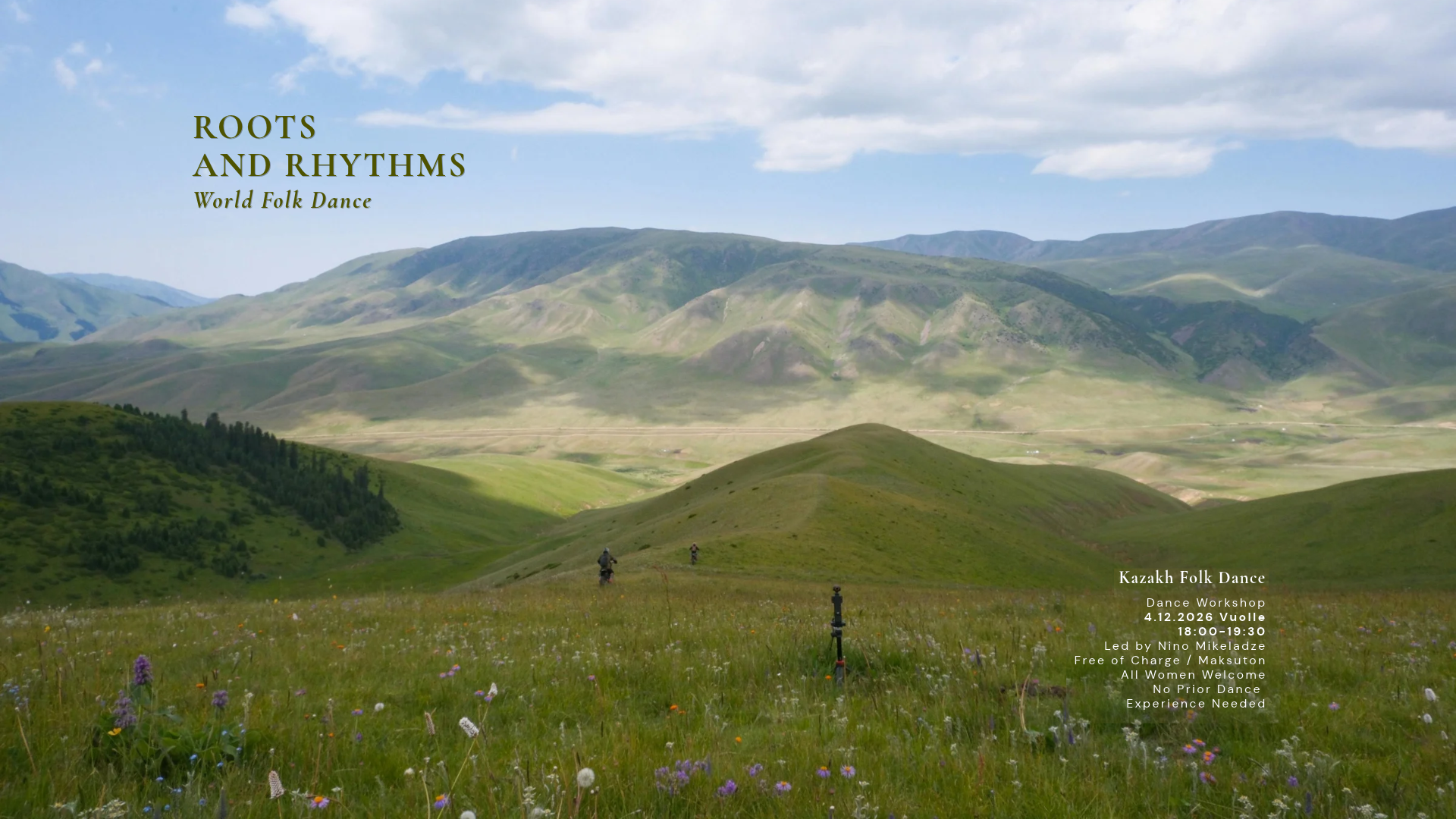
The Steppe Horizon and Dialogue with Space
When you watch Kazakh folk dance for the first time through the eyes of someone from another culture, the first thing that strikes you isn’t the technique itself, but a distinct sense of space. In many dance traditions around the world,movement is built around crisp foot rhythms, sharp accents, or a closed circle.
In Kazakh dance, by contrast, the body feels as though it is entering a dialogue with an endless horizon. It turns out that nature and the surrounding world played a major, central role in shaping this dance — yet not the only one. In the movement, you can feel the breath of the open steppe, mountain wind, and a nomadic way of life, where nature was never treated as mere scenery — it was home, teacher, and the primary source of beauty.
Origins and Influences: From Nomadic Life to the Stage
Kazakh dance took shape at the intersection of different layers of culture and ways of living:
- Nomadic life and customs: For a long time in steppe culture, movement was woven into everyday life, rituals,celebrations, and oral arts — aitys, küy, and songs. Dance was not separate from life; it grew out of it.
- Influence of nature and crafts: The steppe, mountains, rivers, and household work shaped its rhythm, movement quality, and imagery.
- Twentieth-century stage choreography: Starting in the 20th century, folk images and motifs were reimagined for the stage — developing theatrical movement vocabulary, floor patterns, and ensemble presentation while staying connected to ethnographic roots.
- A contemporary approach for beginners: When we bring these images into the studio for beginners with no prior experience, the main goal isn’t “athletic acrobatics” or a rigid drill, but a gentle introduction to posture, breath, and imagery.
Ornament and Gesture: One Visual Language
As you immerse yourself more deeply in this culture, a remarkable unity begins to stand out: in the Kazakh tradition,dance, ornament, and everyday life speak the same visual language. The same smooth, rounded lines that for centuries adorned felt carpets, yurts, garments, and silver jewelry — zoomorphic motifs like ram’s horns (qoshqar müiiz), steppe grasses, geometric talismans, and signs of the sun, moon, and water — come alive in a dancer’s movement.
Her arms don’t merely accompany a step; they seem to draw an invisible oiu-örnek pattern in the air. Movement rolls in a soft wave from shoulder through elbow to wrist and fingertips, echoing a steppe river flowing or feather grass swaying in the wind.
Nature and Women’s Craft in Motion
What moves me especially is how tenderly this dance preserves the memory of the living world and women’s craft. To an outside observer, it unfolds like poetry without words:
- in the light, clean glide of the arms, you glimpse a swan (Aqqū) — a symbol of femininity and dignity;
- in a wide, proud spread of wings, the image of a golden eagle (Bürkıt) or a swift swallow (Qarlyğaş) emerges;
- in the springy, lively pulse of the step, you hear the tread of a steppe steed (tūlpar).
Alongside these soaring images of nature live warm, grounded gestures from labor and craft dances: one hand seeming to steady fabric while the other delicately and patiently “threads a needle” and draws a silk thread (keste tıgü), or hands evoking work at a weaving loom (Örmek bı). There is not a trace of heaviness in it: everyday women’s work turns into elevated art, full of inner light and quiet pride. In Kazakh dance, there are whole expressive hand and wrist movements — “flower,” “sun,” “river,” and others — that bring the picture to life even more vividly.
Growing up with Georgian dance culture, I find this contrast especially fascinating. In Georgian folk dance, human stories and relationships always stand at the center: the unity of warriors in a martial dance, a man’s respectful and noble courtship in a wedding dance, or the proud joy of a mountain celebration. Even when a dancer borrows the lightness of a deer or the poise of an eagle, the language remains fundamentally about human character and interaction. In Kazakh dance, however, the dancer mirrors nature itself — you can watch it like a living landscape in motion, where the body reflects flowers, wind, flowing water, and birds.
Inner Support and the Biomechanics of Grace
Yet perhaps the most surprising discovery comes when you explore Kazakh dance not only with a spectator’s eyes, but through body biomechanics. Beneath the outward lightness and “floating” of the upper body lies a fine inner architecture.
In Kazakh dance, there are many ways to engage the torso: tilting it side to side, forward and back — standing, sitting on the floor, in a plié, or with crossed legs in a plié. All of this demands not only core strength and flexibility, but also subtle,collected balance.
For the spine to stay calm and regal while the thoracic spine opens gently into back extensions and smooth side bends, the body needs deep inner support. When weight shifts intelligently from the knees and ankles into the hip joints during soft bends and flowing steps, and deep core muscles hold the axis of the spine, tension falls away. Dance stops being just vertical or side-to-side movement — it becomes a living, buoyant stream that floats through space and seems to rise toward the sky.
And in that, you hear once again the voice of ancestors who looked at the world with pure wonder — and perhaps a touch of envy, wishing they could soar freely above the earth themselves. Or perhaps they did soar: when honor, victories, wine,or love give a person wings, walking on the ground is no longer enough — you want to fly.
An Outside Gaze That Becomes Your Own
Understanding how a single movement brings together respect for nature, the memory of craft, proud carriage, and wise freedom of the body, you begin to see Kazakh dance not as exotic ethnography, but as a living, universal philosophy of movement — about staying rooted in the earth while feeling as light as the steppe wind.
The participants were not born Kazakh, carrying that natural, deep-rooted poise and pride in their heritage—and without that inner anchor in dance, it is easy to lose the very spark that draws the eye and fills an audience with pride.
That is why our greatest source of strength lies elsewhere: allowing ourselves to enjoy every movement, to smile, to let go of the fear of making mistakes, and to fully immerse ourselves in the beauty of gesture, our femininity, and the possibilities of our own bodies. When they step onto the stage—even without extraordinary abilities, natural flexibility, or prior physical training—I want them to shine as individuals: vibrant, self-assured, and in love with the very process of play and dance. And right beside them, there will always be the support of a team that uplifts and inspires confidence.
At the same time, we will move forward with deep respect for tradition and genuine curiosity—learning this new language of movement and thoughtfully interpreting it through our own bodies, our own experiences, and our living presence.
3 Folk Dance Analysis
Aqqū (Аққу / The Swan) — Poetic Grace and Inner Dignity
Closely associated with the celebrated choreographic legacy of Shara Zhienkulova, Aqqū (The Swan) is one of the most lyrical and refined works in the Kazakh folk dance repertoire.
- Symbolism and Imagery: In Kazakh culture, the swan (aqqū) is a revered emblem of devotion, purity, gentle femininity, and quiet nobility. Rather than merely mimicking a bird, the dancer embodies its spirit — serene,poised, and luminous.
- Mood and Essence: The dance feels like calm poetry in motion, akin to gliding across a still steppe lake at dawn.Unhurried and breathing naturally, Aqqū conveys emotional depth and effortless grace without theatrical excess.
- Movement Quality: Its signature beauty lies in seamless, continuous flow — waves of movement traveling from the core and shoulders through the elbows, wrists, and fingertips like wings rising and settling in slow, measured breath. Beneath that weightless glide is steady inner support: a calm, regal spine, an open chest, and soft, grounded legwork that keeps the entire body in unhurried harmony.
Zhetigen (Жетіген) — Dance as a Living String Instrument
Inspired by the ancient Kazakh plucked box zither of the same name (zhetigen, linked to zheti, meaning “seven” strings),Zhetigen is a lyrical stage dance where music becomes visible through movement.
- Symbolism and Imagery: Known for its silvery, resonant, harp-like timbre, the zhetigen carries associations of emotional depth, memory, and quiet femininity. In this dance, the performers become both the musicians and the instrument itself — their fingers and hands seem to pluck invisible strings in the air while their bodies echo the lingering resonance of the melody.
- Mood and Atmosphere: Serene, contemplative, and luminous, Zhetigen evokes the stillness of a steppe evening and the delicate shimmer of traditional string music.
- Movement Quality: The choreography highlights intricate, expressive finger and wrist articulation flowing seamlessly into soft arm waves, paired with a calm, regal spine and gliding steps. In ensemble versions, dancers often move in sequential ripples or canons, visually mirroring notes cascading across the strings.
Erke Sylqym (Ерке сылқым) — A Portrait of Playful Grace
Set to the iconic küy (traditional dombra composition) of the same name by composer Abdimomyn Zheldibayev, Erke Sylqym is one of the most beloved and recognizable dances in the Kazakh folk repertoire.
- The Meaning Behind the Name: In Kazakh, erke evokes a cherished, spirited, and tender young woman, while sylqym describes someone poised, coquettish, and radiant. Together, the title paints a portrait of a lively young Kazakh woman — playful, light-hearted, and charming, yet carrying a natural sense of dignity.
- The Story and Mood: The dance celebrates youth, springtime, and the pure joy of movement. The dancer moves as if playing with the steppe breeze and the gentle chime of her silver hair ornaments (sholpy), teasing and enchanting the audience with effortless warmth.
- Movement Quality: Driven by the sparkling, brisk rhythm of the dombra, Erke Sylqym is filled with crisp, buoyant steps, subtle shoulder accents, expressive wrist flourishes, and a springy, grounded posture that keeps the upper body light and radiant.