
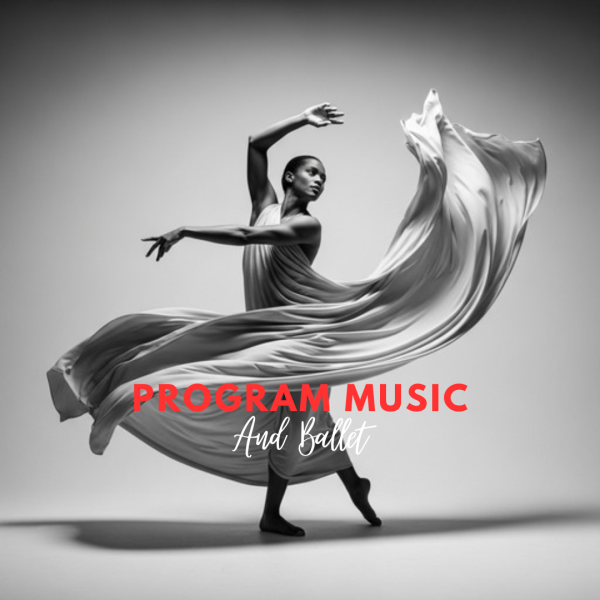
The Philosophy, Debates, and Ballet Connections of Program Music
Program music is not just a way to tell stories with an orchestra. For centuries, it has also been an aesthetic battleground, a philosophical question, and a bridge between art forms. When music began to depict streams, storms, legends, and inner worlds, it changed the direction of Western art — and ballet was one of its greatest beneficiaries.
But before program music found its way onto the ballet stage, it underwent a long and intense evolution.
For a long time, classical music felt like a two-part world to me: the works of Mozart, Beethoven, and other great composers before the 20th century — and then modern classical music. I thought that was all. But then I encountered an idea that transformed my entire understanding of classical music: program music.
This discovery opened a door into the philosophical core of music and revealed how music differs from dance. Dance is inherently diverse: different styles compete for their own expressive languages, traditions, and embodied stories. Music, on the other hand, had long been viewed as a “pure-sounding” art — sound that did not need a narrative.
Program music shattered that assumption.
When program music rose to prominence in the 19th century, it didn’t just transform orchestral music. It revolutionized ballet — an art form that had long been searching for deeper drama, more coherent storytelling, and music that didn’t merely accompany but spoke.
Ballet and program music are like two complementary elements: one gives the body a story, the other gives the story a voice.
What is Program music?
Program music is instrumental music that depicts something outside of music itself: a story, a landscape, a myth, a poem, a historical event, or a natural phenomenon. It gives the listener a program — a small key to what the composer wants to portray.
But long before program music became mainstream in the 19th century, its roots were already deep in earlier centuries as the 1600s and 1700s. These works were not yet considered “official” program music, but their descriptive nature was unmistakable:
- Jean-Philippe Rameau’s harpsichord piece Poules (Hens) imitates clucking so vividly you can almost see the feathers flying.
- Caccia-style hunting pieces used fugue-like chases and horn calls.
Vivaldi’s Four Seasons includes skating, chattering teeth, thunder, and barking dogs — all described by the composer himself.
These works were not labeled program music at the time because their descriptiveness relied on imitation. But they laid the groundwork for what was to come.
And birds — composers’ eternal favorites — have remained central figures in program music to this day.
The Great debate over program music
In the 19th century, the musical world split into two camps:
- The Advocates of Program Music: Berlioz, Liszt, the Russian nationalist composers, Saint-Saëns, Richard Strauss, Debussy, Ravel… They believed music could and should tell stories, depict the world, and reflect human experience.
- The Defenders of Absolute Music:
Their icon was Eduard Hanslick, who declared that the content of music consists of “tonally moving forms” — not stories, not images, not programs. This was not merely an aesthetic disagreement. It was: philosophical, political, national, commercial.
Program music was sometimes dismissed as too entertaining, sometimes as too elitist. Absolute music was criticized as cold and detached.
Franz Liszt was one of the great theorists and innovators of program music. His symphonic poems often drew on literature: Tasso, Les Préludes, Mazeppa, Hamlet Liszt did not claim that all music should be programmatic. He distinguished between two types of composers:
- The “pure symphonist”: leaves interpretation entirely to the listener’s imagination.
- The “poetic symphonist”: wants to ensure the message is understood — and therefore uses a program.
Richard Strauss continued this tradition at the turn of the 20th century with brilliant orchestration and dramatic subjects.
The Symphonic Storytellers:
Beethoven and the Great Turning Point
In the early 1800s, programmatic thinking gained new power. Beethoven was a central figure in this shift. Wellington’s Victory (1813) A flamboyant, humorous, wildly popular piece depicting the Battle of Vitoria:
- cannons thunder
- national melodies clash
the French theme sinks into minor as defeat approaches
Originally written for Johann Mälzel’s mechanical orchestra, the panharmonicon, the piece shows Beethoven’s playful side.
The Pastoral Symphony (1806) Beethoven’s Sixth Symphony is the true watershed of program music. Although he said it was “more an expression of feeling than painting,” each movement clearly depicts:
- arrival in the countrysidea brook and birdsong
- peasants’ dance
- a thunderstorm
a hymn of gratitude after the storm
This work opened the door for the symphony to become more than an abstract structure — it could be a narrative.
Smetana’s Moldau
Bedřich Smetana’s Moldau is a perfect example of how a composer can guide the listener through music like a film:
- two springs, one warm and one cold
- the merging of streams
- hunting horns
- a wedding celebration
- water nymphs dancing
- rapids
the majestic silhouette of Prague
Smetana wrote the program himself — like a screenplay — and the listener can follow the music like a map. But here lies the paradox of program music: If you don’t know the story, you may not miss it. If you do know it, you may notice details that amuse or irritate you — like the abrupt ending that doesn’t match the program’s promised “fading into the distance.” The program can enrich listening, but it can also over-direct it.
The romantic era: when program music exploded
In the mid-19th century, program music became a massive phenomenon:
- the Romantic spirit: literature and music grew closer, and subjective experience became central
- expanding concert life: audiences wanted works with evocative titles and clear narratives
- the orchestra grew: new instruments and harmonies made descriptive music more powerful
- reaction against classicism: composers sought freer forms than the traditional symphony
Forms of program music included:
- the program symphony — like Berlioz’s Symphonie fantastique (1830), a novel for orchestra
- the symphonic poem — Liszt’s invention, a single-movement narrative
- concert overtures — like Mendelssohn’s Hebrides (Fingal’s Cave)
- expanded symphonies — like Mahler’s Titan, combining text and music
narrator + orchestra — Prokofiev’s Peter and the Wolf, Stravinsky’s The Soldier’s Tale
Programmatic thinking also flourished in piano music: Schumann, Liszt, Grieg.
Program Music and Ballet
Program music did far more than reshape orchestral writing — it transformed the entire landscape of the performing arts. Once music began to carry stories and imagery without words, it opened new creative possibilities for every art form that relied on narrative, emotion, and atmosphere. Ballet, in particular, found in program music the partner it had been waiting for.
In the 1700s, ballet was often decorative, light, and episodic. Music served primarily as rhythmic support for dance, not as an independent artistic force. Stories were loose, and the music shifted from scene to scene without deeper dramaturgical logic. But when program music began to flourish, ballet gained a new possibility:
- music could depict events, create atmosphere and tell a story without words
This was revolutionary for ballet. As program music rose, ballet evolved toward a more unified theatrical art. Composers and choreographers quickly realized that programmatic music offered exactly what ballet needed:
1. A clear dramaturgical structure. When the music had a narrative, the ballet gained a spine. No more disconnected numbers — the work became a cohesive whole.
2. Emotional depth. Program music was rich with feelings, symbols, and inner worlds — ideal for a wordless art form built on emotion.
3. Visual imagination. Nature, myths, history, fantasy — all central themes of program music — translated beautifully into movement and stage imagery.
Without program music, many of the most beloved ballets would be unthinkable. It is programmatic thinking that gives us:
- the supernatural forest of Giselle
- the shimmering, enchanted lake of Swan Lake
- the fantastical dreamscape of The Nutcracker
- the tragic emotional sweep of Romeo and Juliet
the ritualistic, earth‑shaking energy of The Rite of Spring
In these works, the music does not follow the dance — it leads it. Ballet discovered in program music a perfect creative ally: a narrative engine, an emotional guide, and a world‑builder.
And the legacy continues. Even though many 19th‑century programs are unfamiliar to modern audiences — who still knows Zarathustra, Harold in Italy, or the political nuances of 1812? — the music itself remains alive. In ballet, the influence of program music is everywhere:
- modern ballets still rely on story, imagery, and atmosphere
- film music — the direct descendant of program music — has shaped contemporary ballet dramaturgy
composers continue to write works inspired by names, poems, myths, and philosophical ideas
As the young composer Sauli Zinovjev remarked about his own concerto, sometimes one poem says everything. The same is true for program music: a single idea can open an entire world.
Ballet’s Programmatic Revolution
Between the 1830s and 1850s, Romantic ballet emerged, and at its heart pulsed a new artistic force: programmatic thinking. Ballet was no longer just decorative movement — it became a world of atmosphere, emotion, and storytelling shaped directly by the music.
Early masterpieces show how deeply programmatic ideas had already taken root:
- Giselle (1841) — a supernatural tale where the music paints forests, spirits, and tragic love with haunting clarity.
- La Sylphide (1832) — a dreamlike realm of fairies and humans, carried by music that breathes mist, magic, and longing.
Even though these scores were not yet fully symphonic, their composers used unmistakably programmatic tools: leitmotifs to identify characters, mood painting to shape scenes, and nature imagery to build entire emotional landscapes.
Programmatic thinking didn’t fade with the Romantic era — it evolved. In the 20th century, some of the most groundbreaking ballets were built entirely on programmatic foundations:
- Stravinsky — The Firebird, Petrushka, The Rite of Spring
- Prokofiev — Romeo and Juliet, Cinderella
- Ravel — Daphnis et Chloé
These works are not simply ballets with music. They are perfect unions of program music and dance. The music doesn’t just accompany the choreography — it creates the world in which the choreography can exist. It shapes the narrative, defines the characters, and drives the emotional arc.
In these ballets, program music becomes the invisible architect: the force that turns movement into meaning, and meaning into art.
Conclusion
Program music began as a bold challenge to the idea that music should exist without meaning, yet it grew into one of the most powerful engines of storytelling in Western art. Program music taught composers to paint with sound — and taught ballet to dream in movement. From Romantic symphonies to the great ballets of the 19th and 20th centuries, it reshaped how composers imagined sound — and how dancers embodied it. Today, whether in a concert hall, a ballet studio, or a film score, the legacy of programmatic thinking continues to flow like a river: carrying images, emotions, myths, and memories. It reminds us that music does not merely accompany life — it narrates it. In the end, program music reminds us that imagination is not separate from sound — it is woven into it.
Sources
Britannica. The Moldau. https://www.britannica.com/topic/The-Moldau
Britannica. Program music. https://www.britannica.com/art/program-music
Musiikin Historia. Orkesterin ja orkesterimusiikin uudistajat: ohjelmasinfonia ja sinfoninen runo. https://muhi.uniarts.fi/rom_ork_ger3/
Tunneorkesteri. Ohjelmamusiikki – mitä se merkitsee? https://tunneorkesterisi.com/2018/02/05/ohjelmamusiikki-mita-se-merkitsee/
Wikipedia. Beethoven. https://en.wikipedia.org/wiki/Ludwig_van_Beethoven
Wikipedia. Program Music. https://en.wikipedia.org/wiki/Program_music
Related posts:
No related posts.