
Excelsior
Ballet Extravaganza
This spectacular ballet is in six act, and 11 tableau, each depicting significant milestones in human progress. These include the invention of the iron bridge, the steamship, telegraphy, and the construction of the Suez Canal and the Mont Cenis tunnel. It was conceived at a time when the public’s taste for ballet had declined into hunger for lavish entertainment but also when Italian national optimism was at a peak. (Excelsior.)
It features human progress (allegorical characters) in terms of a tumultuous struggle between progress and ignorance. The central theme of Excelsior is the celebration of human ingenuity and the positive impact of technological advancements. It reflects the optimism of the late 19th century and the belief in progress and enlightenment. (JSTORE; Excelsior.)
The choreography for the original production was arranged for several hundred of dancers and was lavishly staged. It was visually stunning and thematically rich. (JSTORE; Excelsior.) The designer Alfredo Edel made Excelsior successful, with hundreds of elaborate costumes and spectacular sets such as an Egyptian desert that turns into a festive site, a mountain tunnel, and a multitiered stage for the big allegorical numbers (among others). The music by Romualdo Marenco enhanced the dramatic and celebratory tone of the ballet. (JSTORE.)

History
Excelsion premiered on 11 january 1881 at Teatro alla Scalla, with Bice Vergani, Carlo Montana, and Rosina Viale. It was choreographed by Luigi Manzotti, sets and costumes designed by Alfredo Edel, and music composed by Romulado Marenco (Excelsior.). Ballet was extremely popular and was revived all over Europe and beyond. In Vienna it was in the repertory from 1885 to 1914, receiving 329 performances. Notable restaging’s were by dell’Ara for the Teatro Communale, Florence (1967), and for La Scala (1974). (Excelsior.)
Excelsior is recognized as a national treasure of Italy choreographed and staged by genius Luigi Manzotti (2.2.1835 – 15.3.1905), who was an Italian ballet dancer, mime and choreographer. Manzotti was a master of pantomimic and crowd scenes (over 600 participants) which he actively included in his performances. In Excelsior we see obscurantism as a pantomime character at heart.
Manzotti’s ballets usually consisted of a number of episodes of historical or allegorical content. His patriotic ballet-extravaganzas, were glorifying the progress of science and technology. It is especially showcased in Excelsior. (Mazotti Luigi.)
The desire for entertainment and colorful spectacle, the belittling of the role of classical dance, and the exaggerated attention to staging effects reflected the characteristic symptoms of the decline of European ballet at the end of the 19th century. Some of Manzotti’s techniques influenced the development of music hall art and some ballet performances of the 1910s and 1920s. (Mazotti Luigi.)
Ugo Dell’Aran’s reconstruction of Excelsior
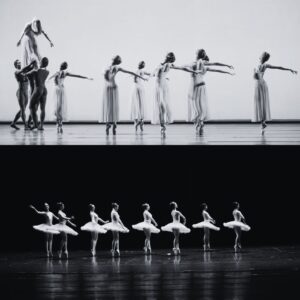
The video (filmed in 2002) represents Ugo Dell’Aran’s reconstruction of spectacular and ,,extravaganza’’ ballet Excelsior, by Luigi Mazotti. Dell’aran used Manzotti’s original libretto and choreography for recreation (Description of the video; Excelsior.) Dell’Ara’s 1967 version emphasized classical dancing over mime, (JSTORE), and as a result, this video may represent more of classical dancing then the mime.
So while the original 1881 version was often described in terms of 6 acts, Dell’Ara’s 2002 version simplifies it into 2 parts, retaining the 11 tableaux that represent the key allegorical and technological milestones.
One of the finest reconstructions and recording ofExcelsior – a true gem of ballet history. Here are my notes on the structure of this remarkable performance.
Ballet Structure
|
2 Part Ballet |
Tableau / Theme / Event |
Dance Style / Choreographic Theme |
|
Part I
emphasizes the rise of technology and the defeat of ignorance |
|
Classical ballet; allegorical pas de deux and corps de ballet |
|
Ensemble dance; industrial-themed movement
|
|
|
Male corps; mechanical, rhythmic choreography |
|
|
Male corps; mechanical, rhythmic choreography |
|
|
Pas de caractère; stylized gestures mimicking telegraphy |
|
|
Orientalist ensemble; fusion of classical and folk motifs
|
|
|
Part II
showcases the fruits of progress—unity, knowledge, and peace |
|
Group dance; dramatic, labor-themed choreography
|
|
Expressive solo; emotive modern ballet elements |
|
|
Character dances; national styles (Spanish, Russian, etc.)
|
|
|
Grand pas; celebratory classical ballet
|
|
|
Grand pas; celebratory classical ballet
|
My take
Ballet is impressive, in many ways: costumes, music, choreography, theme, and story line. I enjoyed the celebration of Positivism showing the advances that mankind was making through the science and industry. Every time when enlightenment and progress were banishing the obscurantism and the world was changing for better, as a viewer could not stayed indifferent. I agreed and celebrated with every thought of the storyteller.
Ballet Excelsior for it’s topic and story line, surprisingly for me, turned out to be very modern, vivid and relevant. It showcases our ancestors problems and struggles, which compared with modern day huge topics (cataclysms, environment issues and so on) has somehow romantic, idyllic and innocent touch. Ballet and its – progress glorifying attitude, brings also a touch of hope – that no matter what, even with our modern struggles we will survive, or find our way out – because enlightenment, civilization and progress are fighting continuously for the good, the better, for the mankind. We just need to move forward, be curious, learn more, show persistency, courage, care about surrounding and during this process: enjoy life.
Sources
Excelsior. Oxord Reference. Accessed 12.8.2024. Excelsior – Oxford Reference
JSTORE. Review: Two Balletic Sensations: Excelsior and the Ballet of the Nuns. Accessed 17.8.2024. Review: Two Balletic Sensations: Excelsior and the Ballet of the Nuns on JSTOR
Manzotti Luigi. Big encyclopedia Russia. «Большая российская энциклопедия». Accessed 18.8.2024. Манцотти Луиджи. Большая российская энциклопедия (bigenc.ru)