Global imagination, rivalry, Portugese prestige, ambiguities of empire and cartographic imagination
Camões’ Os Lusíadas is not just a national epic but a world epic. By rivaling Homer, surpassing Virgil, and grounding poetry in lived exploration, he positions Portugal at the center of a new global imagination. His work marks the shift from mythic journeys to real voyages, from Mediterranean fantasy to worldwide reality.
And this masterpiece was the theme of the week six in Harvard. Held by Professors Martin Puchner, David Damrosch and Katarina Piechocki, who emphasized that Camões’ epic is not merely a monument of Portuguese identity but a lens through which we can read the birth of globalization. The poem stages encounters between myth and history, Europe and Asia, poetry and politics. Os Lusíadas is less about the past than about how we imagine the world today: interconnected, contested, and still haunted by the voyages that first stitched continents together. What follows are my notes and reflections from the lecture.
Camões — The Portuguese Writer of Global Imagination
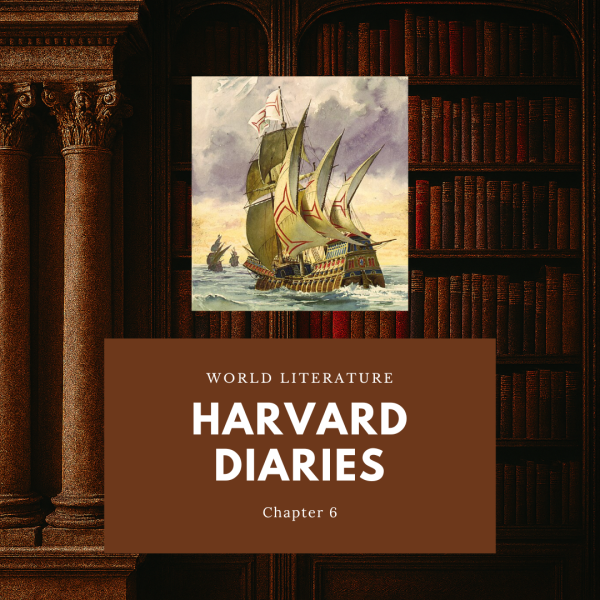
Luís de Camões, author of Os Lusíadas (1572), stands as the founding figure of Portuguese literature and one of the first poets to imagine the world as a whole. His epic poem is not confined to the Mediterranean basin, nor to the mythic landscapes of antiquity. Instead, it charts the voyages of Vasco da Gama and the Portuguese sailors who opened sea routes to India, Africa, and Asia. In doing so, Camões inaugurates what can be called the first global imagination in literature.
Unlike Homer, who relied on inherited myth and oral tradition, Camões wrote from direct experience. He traveled to Goa, Macau, and other parts of Asia, fought in battles, and endured exile. His epic is infused with the authority of lived observation. When he describes waterspouts in the South Atlantic or lightning striking a ship’s mast, he insists: “You will not believe, but I saw.” This insistence on vision and reality marks a radical departure from the mythic fables of earlier epics. Camões’ work thus becomes not only a national monument but also a literary map of the globe, embedding Portuguese expansion into the very fabric of poetry.
Rivalry with Homer
Camões’ relationship with Homer is one of both admiration and rivalry. He acknowledges Homer as the father of epic poetry, yet he critiques the imaginative geography of the Odyssey. Ulysses’ wanderings, however vivid, remain confined to the Mediterranean and are populated by fantastical beings—Scylla, Charybdis, Calypso, and the shades of the underworld. Camões dismisses these as “empty fables,” polished with metaphor but lacking substance.
By contrast, Os Lusíadas presents voyages across actual oceans, charting real coastlines and encounters. Camões positions himself as surpassing Homer: where Homer’s blind imagination conjured myth, Camões’ half‑blind vision (having lost one eye in battle) records reality. This rivalry is explicit in Canto V, where Camões asks whether Aeneas or Ulysses ever dared to embark on such journeys. His answer is clear: they did not. The Portuguese sailors, guided by strategy and courage, ventured farther than any ancient hero. Thus Camões both honors Homer as a model and claims superiority by grounding his epic in empirical exploration.
Portugal’s Prestige
The creation of Os Lusíadas must be understood within the context of Portugal’s rise as a maritime empire in the sixteenth century. Politically and economically, Portugal had established trading posts and colonies across Africa, India, and Asia. Yet culturally, it lacked the prestige of Greece, Rome, or Italy. Camões’ epic sought to fill this gap by providing Portugal with a literary monument equal to its global power.
The opening lines of the poem reveal this ambition. By rewriting Virgil’s “Arms and the man” into “Arms and the heroes,” Camões transforms the epic into a collective enterprise. It is not the story of one man’s destiny, but of a nation’s daring. In doing so, he elevates Portuguese identity to the level of classical antiquity. The poem thus functions as both celebration and legitimation: it glorifies Portugal’s voyages while embedding them in the lineage of Homer and Virgil. Through Camões, Portugal claims cultural prestige to match its imperial reach.
The Big Picture — From Mediterranean to Global Imagination
Homer’s imagination was Mediterranean: his heroes wandered among islands and mythic seas, their journeys bounded by the geography of Greece and Italy. Virgil’s imagination was Roman: his epic constructed an imperial myth of destiny, linking Troy to the founding of Rome.
Camões, however, expands the horizon. His imagination is global. The Indian Ocean becomes a mirror to the Mediterranean, but this time mapped and experienced. The Portuguese voyages transform the epic from mythic fantasy into world literature. Camões insists that his tale, in its “naked purity,” outdoes all boasting and hyperbole because it is real. In this way, Os Lusíadas marks a turning point: the epic becomes a genre not only of myth and empire but of exploration and global encounter.
The rivalry with Homer thus serves a larger purpose. By surpassing the Mediterranean imagination, Camões inaugurates a new literary geography—one that reflects the interconnected world of the sixteenth century. His work is both a national epic and a world epic, positioning Portugal at the center of a new global consciousness.
Literary Mapping and Cartographic Mapping
Where Homer’s Odyssey wanders through untraceable fantasy worlds, Camões sets himself the task of mapping the globe in a way that claims accuracy. His epic begins in medias res with Vasco da Gama’s arrival on the southern coast of Africa—territory no European had seen before—and proceeds eastward across the Indian Ocean to Asia. Much like a portolan chart, the poem unfolds through landfalls and ports, each encounter marked by names and places. The epic culminates in a sweeping panorama of Asia, a catalogue of locations that mirrors the lists of a mapmaker.
Camões deliberately sets his narrative seventy‑five years before his own time, during Vasco da Gama’s voyage of 1497–99, just five years after Columbus crossed the Atlantic. Yet he infuses the text with his own contemporary experience. The waterspout described in Canto V, for instance, is not something Da Gama saw but something Camões himself witnessed. Thus the epic becomes a hybrid: part historical commemoration, part personal testimony. The mapping is not only geographic but also ethnographic, recording encounters with radically new peoples and cultures.
These encounters reveal the first sustained European attempt to grapple with cultural multiplicity on a global scale. Camões’ descriptions are schematic, reducing the unfamiliar into categories that could be understood. He distinguishes between two broad groups: natives and Muslims. The natives are often divided into “good” and “bad”—those who offer food and hospitality versus those who threaten cannibalism. Africans on the southern coast of Africa embody this dichotomy, yet they also serve as crucial navigators, providing local knowledge that guides the Portuguese into the Indian Ocean.
The encounters with Muslims highlight the religious rivalries of the age. Islam is not portrayed as a local faith but as part of a vast trading empire, a rival to the emerging Christian empire of Portugal. These meetings echo the broader struggles in the Eastern Mediterranean, where the Ottoman Empire pressed against Europe. At times, Camões even acknowledges an uneasy truth: some of these “barbarians” are more civilized than Europeans themselves, echoing Homer’s ambivalence about the peoples beyond Greece.
In India, the mapping becomes even more complex. Camões records moments when the Portuguese mistake references to Krishna for Christ, conflating unfamiliar gods with familiar categories. This reveals the limits of European understanding, where the binary of Christian versus Muslim becomes the default lens through which all religions are interpreted.
Finally, Camões’ mapping is also linguistic. He notes the role of Swahili as a lingua franca around the Indian Ocean, a language blending Arabic with local elements. Portuguese sailors rely on shipmates who speak Arabic to communicate in a pidgin form with Swahili speakers. This linguistic awareness underscores the practical realities of navigation and trade, where communication across cultures was as vital as charts and compasses.
In sum, Os Lusíadas performs a double mapping: it charts coastlines and ports with cartographic precision, while also mapping peoples, religions, and languages with ethnographic curiosity. This literary mapping parallels the cartographic mapping of the age, transforming the epic into a global document. Where Homer’s geography was mythic and untraceable, Camões’ geography is empirical, schematic, and deeply entangled with the realities of empire, trade, and cultural encounter.
Classical Antiquity Reimagined — Bacchus, Adamastor, and the Ethics of Nemesis
Camões’ Os Lusíadas is remarkable not only for its global mapping but also for its bold integration of classical antiquity into a Christian epic. The poem unfolds against the backdrop of two rival monotheistic religions—Christianity and Islam—yet it is populated by Greek and Roman gods. Bacchus emerges as an antagonist, while the titan Adamastor looms over Africa as a newly invented mythic figure. These deities are not invoked as objects of belief but as part of a deliberate literary genealogy. By weaving them into his narrative, Camões connects himself to Homer and Virgil, thereby shoring up his credentials as heir to the classical epic tradition.
This strategy reflects a broader European tendency that would persist for centuries: interpreting polytheistic cultures encountered abroad through the lens of classical paganism. Indian pantheons, African animisms, and Asian cults were understood as analogues to Greek and Roman gods. Camões’ Bacchus, for instance, becomes a god of India, echoing Euripides’ Bacchae, where Dionysus is portrayed as an Eastern deity whose acceptance in Greece is contested. In this way, Camões both draws on his classical training and anticipates later discoveries of Indo‑European linguistic and mythological commonalities. His decades in Asia gave him the confidence to relate foreign gods to familiar classical archetypes, intuiting connections that scholarship would confirm centuries later.
Yet Camões does more than borrow classical figures; he retools them with realism. His critique of Homer is that Homer did not know reality. Thus, when Camões invents Adamastor, he slyly blends fantasy with empirical detail. Adamastor, modeled on Polyphemus, is introduced in comic terms—his sheer size makes him incapable of raping a nymph—but quickly shifts into grim realism. His curse against the Portuguese is not mythic delay, as with Polyphemus’ curse on Odysseus, but stark historical tragedy: shipwrecks, starvation, and violent deaths of future adventurers. Adamastor embodies the dangers of empire, a mythic figure rooted in the real geography of Table Mountain in southern Africa. Where Homer’s monsters inhabit untraceable fantasy, Camões’ titan is anchored in a landscape Europeans had actually seen. In this sense, Camões discovers a “new antiquity,” projecting classical myth into newly charted territories.
The ethical dimension of this classical inheritance is equally striking. Camões invokes Rhamnousia—Nemesis, the goddess of retribution—when describing fortune’s punishment of pride and hubris. This reveals his loyalty to classical ethics, which he adapts seamlessly into a Christian framework. The gods may be literary devices, but the moral lessons they embody remain potent. Nemesis punishes arrogance, Adamastor warns against impious ambition, and Bacchus resists the intrusion of Christian explorers. Through these figures, Camões demonstrates that classical myth still speaks to the modern world, offering a vocabulary for both cosmic justice and imperial critique.
Thus, Camões’ use of antiquity is not mere ornamentation. It is a bold attempt to connect old and new, to graft Homeric and Virgilian traditions onto the realities of Portuguese expansion. By inventing Adamastor, reimagining Bacchus, and invoking Nemesis, Camões positions himself as both inheritor and innovator of the epic tradition. His epic does not simply echo the past; it discovers new mythologies in Africa and Asia, transforming exploration into a continuation of classical antiquity. In this way, Os Lusíadas becomes a bridge between the ancient Mediterranean imagination and the modern global imagination, fusing myth with reality to create a new world epic.
Warnings, Curses, and the Ambiguities of Empire
One of the most powerful dimensions of Os Lusíadas lies in its ambivalence toward exploration and empire. Camões celebrates Portuguese daring, yet he also embeds voices of warning and critique. These voices echo ancient epic traditions while speaking directly to the anxieties of his own age.
The parallel with Homer’s Odyssey is instructive. In the Polyphemus episode, Odysseus narrates the Cyclops as barbaric, yet if read against the grain, the Cyclopes are not quite as savage as he claims. Odysseus’ arrogance colors the tale, and Polyphemus’ curse gives voice to those harmed by Greek intrusion. Similarly, in Os Lusíadas, Adamastor’s curse articulates the perspective of those who suffer under Portuguese expansion. His warning is not only for the colonized but also for the colonizers themselves: the empire will bring tragedy, shipwreck, and decline.
Camões reinforces this ambivalence with the figure of the old man of Belém, who warns the sailors against pride and conquest. His speech mirrors Adamastor’s curse, but from a different angle. The old man insists that imperial ventures will harm others, while Adamastor insists they will harm the Portuguese themselves. Together, they form a structural pair: external critique and internal warning. This pairing recalls the old man in Gilgamesh, who cautions against the dangerous journey to the Cedar Forest. Though Camões could not have known the Mesopotamian epic, the recurrence of this narrative structure across millennia suggests a deep cultural continuity: pride and daring are always shadowed by the fear of hubris.
The historical context sharpens this ambivalence. Vasco da Gama’s first voyage yielded immense profits—pepper and cinnamon worth sixty times the cost of the expedition. Spices, sandalwood, Brazilwood, and precious metals fueled a boom that made Portugal briefly dominant in global trade. Yet by the time Camões was writing in the 1560s, decline had set in. Spain’s access to American gold and silver outstripped Portuguese wealth, and Portugal faced growing encroachment from rival empires. Camões’ epic thus reflects both the pride of past triumphs and the anxiety of present decline. His warnings are not abstract: they speak to a nation already fearing the fragility of its empire.
National identity is forged in these rivalries. Camões often calls the Portuguese “Lusitanians,” emphasizing their transformation abroad: “They went out Lusitanians, they came back Portuguese.” Exploration becomes the crucible of identity. Yet this identity is defined not only against the wider world but also against rivals close to home. Spain looms as a competitor, Islam as both religious and economic rival, and Protestant Germany as a threat to Catholic unity. Camões situates Portugal within the Counter‑Reformation, imagining its voyages as a way to compensate for the loss of souls in Europe. Unlike Spain, however, Portugal’s epic is less concerned with conquest and conversion than with trade and navigation. The “good native” is not one who becomes Christian but one who guides the Portuguese along trade routes, as in the figure of the Muslim king of Malindi.
Thus, Os Lusíadas is a text of multiple voices. It celebrates daring and profit, but it also embeds curses and warnings. It affirms national pride, yet it acknowledges decline. It situates Portugal within a global rivalry, but it also questions the costs of empire. Like Homer and Gilgamesh before him, Camões dramatizes the tension between exploration and hubris, between glory and suffering. His epic is not a simple celebration of empire but a layered meditation on its ambiguities, voiced through mythic figures, historical realities, and prophetic warnings.
Language, Realism, and Literary Innovation
Camões’ achievement in Os Lusíadas is not only thematic but linguistic. By writing the first great epic in Portuguese, he elevated a language that had long been considered a mongrel dialect of Castilian. In the sixteenth century, there was not yet a unified “Spanish” language; the Iberian Peninsula was a patchwork of regional tongues. Portuguese was often dismissed as a stepchild of this linguistic family. Camões’ epic changed that perception. He demonstrated that Portuguese could sustain the highest registers of classical epic while also capturing the immediacy of lived experience. In this sense, Os Lusíadas is as much a linguistic monument as a national one: it creates Portuguese as a literary language.
The excitement of this linguistic experiment is palpable. Camões, like his near contemporary Shakespeare, revels in the possibilities of his vernacular. Shakespeare mocked the artificiality of Petrarchan conventions, insisting on flesh‑and‑blood realism in his sonnets. Camões does something similar in epic form. Amid mythological episodes, he inserts passages of striking realism. Just before the apparition of Adamastor, he describes sailors careening their ships, scraping away “sludge and barnacles and limpets” after months at sea. Such details had never appeared in epic poetry before. There is no sludge in Homer, because Homer’s world was imagined rather than experienced. Camões insists that epic must now record the realities of exploration, even its mundane technicalities.
This realism is not only comic but tragic. Cervantes, writing Don Quixote a few years later, parodied the romance tradition by turning giants into windmills. Camões, by contrast, blends myth with tragedy. Adamastor is both a comic giant and a prophet of doom, cursing the Portuguese with shipwreck and decline. The juxtaposition of myth and realism produces haunting lyrical passages. Camões was a great lyric poet, and his sonnets were more widely read in Europe than his epic. In Os Lusíadas, lyrical moments punctuate the narrative, meditating on mortality: “It is so easy to bury a body.” Such lines remind us that the epic is not merely an adventure tale but a moral and metaphysical reflection on human fragility.
Camões’ language itself embodies this tension. His sonnets employ a modern, supple Portuguese, while the epic adopts a more elevated, slightly archaic register, echoing classical models. He is torn between embracing the modern world and anchoring himself in antiquity. This duality places him firmly within the Renaissance tradition of epic ambition. Milton’s Paradise Lost offers a parallel: its Latinate diction recalls Virgil, yet it incorporates contemporary scientific observation. As C.S. Lewis observed, Milton’s choice of biblical subject matter made his style Virgilian; had he chosen Arthurian legend, it would have resembled Spenser. Similarly, Camões’ choice of maritime exploration required a blend of classical grandeur and empirical realism.
In this way, Camões joins Shakespeare, Cervantes, and Milton as one of the great innovators of Renaissance literature. Each exploited the resources of language to redefine literary genres: Shakespeare elevated English drama, Cervantes reinvented prose fiction, Milton created a Christian epic, and Camões transformed Portuguese into a literary language capable of sustaining a global imagination. His work embodies the Renaissance synthesis of Christianity and classical antiquity, realism and myth, lyric and narrative. Os Lusíadas is thus both a national epic and a linguistic experiment, a text that proves Portuguese can carry the weight of world literature.
Ptolemy, Taprobana, and the Cartographic context in Os Lusíadas
Camões’ epic is deeply entangled with the cartographic traditions of his age. Os Lusíadas mobilizes multiple mapping systems—practical, classical, climatic, and symbolic—to create a layered spatial imagination that mirrors Renaissance geography.
Portolan Charts (Medieval–16th century)
- Originated in the Mediterranean, especially among Catalan mapmakers.
- Focused on ports and coastlines, marked with rhumb lines and wind roses for navigation.
- Detailed shorelines but left interiors blank, reflecting the priorities of seafaring.
- Vasco da Gama relied on these charts when circumnavigating Africa. They were practical tools, not encyclopedic maps.
Ptolemaic Geography (2nd century CE, revived in Renaissance)
- Claudius Ptolemy’s Geographia imagined the world as the Oikoumene: three continents (Africa, Asia, Europe) centered on the Mediterranean.
- Rediscovered in the late 15th century, it became the dominant framework for Renaissance cartography.
- In Os Lusíadas, the nymph Thetis shows Vasco da Gama the Ptolemaic world, reinforcing Camões’ classical lineage.
- The New World is barely mentioned (brief references to Tenochtitlan and Magellan in Canto X), underscoring Camões’ focus on Ptolemaic continents rather than America.
- Taprobana: A name from Ptolemaic maps, usually identified with Sri Lanka (sometimes Sumatra). In antiquity it marked the eastern edge of the known world. In Os Lusíadas (1572), Camões invokes Taprobana to signal the Portuguese voyages reaching the “end of the world.” By linking Vasco da Gama’s journey to Calicut (a spice‑trade hub) with Ptolemaic toponymy, he fuses classical geography with Renaissance exploration, showing how literature mirrored cartographic discovery.
Zonal Maps (Macrobius, Late Antiquity)
- Divided the earth into climatic zones: torrid, temperate, frigid.
- Camões references the torrid zone around the equator, dramatizing Vasco da Gama’s passage through supposedly uninhabitable regions.
- This reflects medieval traditions of imagining the world in terms of habitability rather than geography.
Ecological Imagination
- The fierce storms at the Cape of Good Hope and the apparition of Adamastor embody the dangers of geography itself.
- Camões fuses myth with ecological reality, turning natural phenomena into literary symbols of peril and pride.


Renaissance Map Innovations
- Cantino Map (1502): Produced secretly in Portugal to record discoveries in the Indian Ocean and the Americas. Stolen by Alberto Cantino for the Duke of Ferrara. One of the earliest maps to depict both the New World and the Indian Ocean, though “America” was not yet named.
- Waldseemüller Maps (1507 & 1516):
- 1507 Map: First to use the name America, applied to South America. Based on Ptolemaic geography but expanded to include new discoveries.
- 1516 Carta Marina: A portolan‑style chart showing King Manuel I riding a sea monster, symbolically “domesticating” the Indian Ocean.
- Maggiolo Map (1513): Oriented westward, showing parts of the New World, demonstrating how quickly cartography adapted to global discoveries.

Literary parallel
Camões’ Os Lusíadas mirrors these cartographic innovations. While Spanish writers celebrated the Western Indies (the Americas), Camões focused on the Eastern Indies (India, the spice trade, and the Indian Ocean). In Canto Primeiro, he declares the building of a novo reino (“new kingdom”), not merely a “new age.” This phrasing underscores the competitive drive for dominion and expansion, situating Portuguese literature within the same geopolitical rivalries that shaped Renaissance maps.
By weaving together portolan charts, Ptolemaic geography, zonal maps, ecological myth, and Renaissance cartographic innovations, Camões creates a literary cartography that both reflects and rivals the mapping practices of his time. His epic is simultaneously a celebration of Portuguese daring and a fantasy of European primacy, helping establish the myth of Europe as the first global explorer.
Key milestones
- 1580 — Spanish Translations As Portugal was absorbed into Spain, Luys Gómez de Tapia and others translated Os Lusíadas into Spanish. The epic became a tool of imperial incorporation, symbolizing the translatio imperii (transfer of empire).
- 1639 — Annotated Spanish Edition Manuel de Faria e Sousa published a monumental annotated version in Madrid, comparing Camões to Virgil and guiding Spanish readers through the epic.
- 1655 — First English Translation Richard Fanshawe produced the first English version, aligning Camões with England’s growing naval ambitions after the defeat of the Spanish Armada.
- 1776 — English Translation by William Mickle Dedicated to the shareholders of the East India Company, Mickle reframed the epic as “the poem of commerce,” reflecting Britain’s mercantile empire.
- 1880 — Portuguese Canonization Teófilo Braga led commemorations of Camões’ 300th death anniversary, enshrining him as Portugal’s national poet. His remains were moved to the Jerónimos Monastery, and Lisbon’s Praça Camões became a symbol of national pride.
Conclusion: From National Epic to World Literature
The ending of Os Lusíadas is as shocking as it is revealing. Camões closes his epic with a double appeal: a plea for recognition and reward, and a direct exhortation to the young King Dom Sebastião. He positions himself as both poet and adviser, offering his “rough, unworthy voice” as guidance, much like Machiavelli addressing the Medici in The Prince. In his final stanzas, Camões promises to extol Sebastian’s future conquests, invoking classical comparisons to Alexander and Achilles. Yet this literary gesture had devastating real-world consequences. Six years later, Sebastian launched his ill-fated Moroccan campaign, leading 17,000 men—virtually the entire nobility of Portugal—into catastrophe. Fewer than a hundred returned. The defeat at Alcácer Quibir destroyed Portugal’s aristocracy and paved the way for Spanish domination. In this case, poetry did make something happen, and what it made happen was disaster.
This denouement underscores the ambivalence that runs throughout Camões’ epic. He celebrates Portuguese daring, yet he warns against imperial overreach. He recognizes the glory of exploration, yet he voices the suffering it causes. The old man of Belém cautions against pride and conquest; Adamastor curses the Portuguese with decline. Camões himself, exiled for a duel, knew firsthand the precariousness of power. His epic is not a simple nationalist tract but a layered meditation on empire, pride, and mortality. It is precisely this tension—between celebration and critique—that makes Os Lusíadas enduring literature rather than propaganda.
For centuries, the poem was read primarily as a Portuguese national epic, of limited interest beyond the Lusophone world. In Brazil, it was often resisted, seen as a text that objectified rather than represented them. Yet today, in a world marked by economic rivalries, religious conflicts, and talk of civilizational clashes, Camões’ epic emerges anew as a work of startling relevance. It is the first great literary attempt to map global encounters—geographic, ethnographic, religious, and linguistic—into poetry. It dramatizes the ambiguities of empire, the dangers of hubris, and the fragility of human ambition. In this sense, Os Lusíadas is not merely a monument of Portuguese literature but a touchstone of world literature.
Just as Homer provided Camões with a model to emulate and rival, so Camões now provides us with a lens through which to understand our own global conflicts. His epic reminds us that exploration and conquest are never unambiguous, that pride and suffering are intertwined, and that literature can both inspire glory and warn of disaster. To read Os Lusíadas today is to encounter the first epic of globalization, a work that speaks across centuries to the complexities of our modern world.