
Why Diary of a Wimpy Kid Matters
A Deep Dive Into Jeff Kinney’s Genius
This blog post explores the emotional depth, humor, and psychological insight of Jeff Kinney’s Diary of a Wimpy Kid series — and why it resonates so deeply with children, educators, and adults.
Discovering Diary of a Wimpy Kid only last autumn felt like stumbling onto a treasure I somehow walked past for years. I’d seen the movies long ago, but the books… the books are something entirely different. They’re sharper, funnier, more tender, more honest — full of those tiny emotional details that films can never quite hold. Reading them as an adult has been a joy, and, unexpectedly, a small personal revolution.
Working with kids, I’ve noticed how Jeff Kinney’s humor and vulnerability open doors. Greg Heffley and the rest of Kinney’s cast don’t just entertain; they invite children into a world where awkwardness, curiosity, embarrassment, and big feelings are allowed to exist without judgment. When kids see Greg survive his catastrophes — or even cause them — they learn to name their own emotions, laugh at their own missteps, and feel less alone in the chaos of growing up.
Kinney has achieved something rare: a children’s series that makes readers laugh, ache, reflect, and think, all while speaking to them in a language that feels real. Beneath the jokes and the sarcasm lies a remarkable emotional depth. His books are not just stories about a middle‑schooler; they’re mirrors of childhood, friendship, identity, and the fragile, funny process of becoming a person.
Kinney’s Genius
Jeff Kinney possesses a rare gift: he writes as if he has stepped back into childhood, yet he never reduces or idealizes it. Instead, he presents the world exactly as children experience it — chaotic, hilarious, unfair, confusing, and at the same time deeply meaningful. A school lunch, a misunderstanding with a friend, a minor embarrassment in class — each becomes a tiny emotional drama in which readers instantly recognize themselves. This ability to inhabit a child’s consciousness from the inside is what makes Kinney’s storytelling so vivid, truthful, and unforgettable.
Greg and Rowley: two perspectives on one reality
At the heart of the series lies one of the most compelling duos in modern children’s literature. Greg Heffley is a protagonist who desperately wants to appear cooler than he feels. He hides his vulnerability behind sarcasm, masks his kindness with bravado, and often gets tangled in his own contradictions. Rowley Jefferson, in contrast, is open, sincere, emotionally transparent, and unafraid to be himself.
Their friendship is the emotional engine of the series. Next to Rowley, Greg’s insecurities and hidden tenderness become more visible. Next to Greg, Rowley’s innocence shines even brighter. Kinney uses their contrasting worldviews to show how two children can experience the same moment in completely different ways — funny, painful, and authentic all at once.
Humor as a Way to Speak About What Matters
Kinney’s books are undeniably funny — sometimes laugh‑out‑loud, sometimes painfully so. But beneath the humor lies a rich emotional landscape. Through Greg’s voice, we see the fear of rejection, the longing to be noticed, the awkwardness of growing up, and the constant tension between who you want to be and who you really are.
Kinney never moralizes. He simply shows life as it is, and in doing so helps children (and adults) understand themselves. Humor becomes a gentle way to explore difficult topics: identity, friendship, jealousy, embarrassment, and the fragile process of becoming emotionally aware. Greg’s jokes are his shield, and the more he jokes, the more clearly we see the vulnerability behind them.
Kinney as a Phenomenon in Children’s Literature
From a literary perspective, Kinney has created a unique hybrid form: part graphic novel, part diary, part realistic fiction, part social satire. His books blend visual storytelling with psychologically authentic narration, making them accessible to reluctant readers while still offering depth for more advanced ones.
He does not romanticize childhood. He portrays it from the inside — messy, illogical, anxious, hilarious, and profoundly important. This honesty is what sets him apart.
Global Phenomenon and Emotional Power
The global success of the series is no mystery. The combination of text and drawings lowers the barrier to reading. Greg is universal: every child sees a bit of themselves in him, and every adult sees a reflection of their own past. The themes — friendship, self‑esteem, family dynamics, school life — resonate across cultures and generations.
Above all, Kinney writes with sincerity. He does not preach; he observes. The emotional strength of Diary of a Wimpy Kid lies in its honesty. Kinney captures the inner world of a child with all its contradictions — the fears, the hopes, the jealousy, the small victories, the moments of unexpected courage. He shows that kindness is not weakness, that vulnerability is part of growing up, and that even the “wimpiest” kid can possess remarkable inner strength.
Conclusion: Jeff Kinney as a Chronicler of the Child’s Soul
Jeff Kinney writes simply, but his simplicity is deceptive. Beneath the humor lies real psychology. Beneath the drawings lies emotional truth. He writes about children, yet speaks to something universal in human nature.
Diary of a Wimpy Kid is more than a bestselling series — it is an emotional map of childhood, drawn with honesty, warmth, and insight. For parents and educators, it remains one of the most valuable series to place in a child’s hands. It encourages imagination, emotional growth, self‑reflection, and empathy, all while offering a joyful, unforgettable reading experience.
Kinney’s work is light yet profound, humorous yet touching, simple in form yet rich in meaning. It is a treasure for children, parents, teachers, and for anyone who remembers what it felt like to grow up.
And if Jeff Kinney ever happens to read this: thank you. Thank you for the unforgettable laughter, the cozy evenings, the unexpected twists, and the sense of adventure tucked into every page. Your books inspired me, made me feel at home, made me braver and more curious — and they continue to shape the way I work with children. Wishing you all the best, and looking forward to every new story you choose to share with the world.
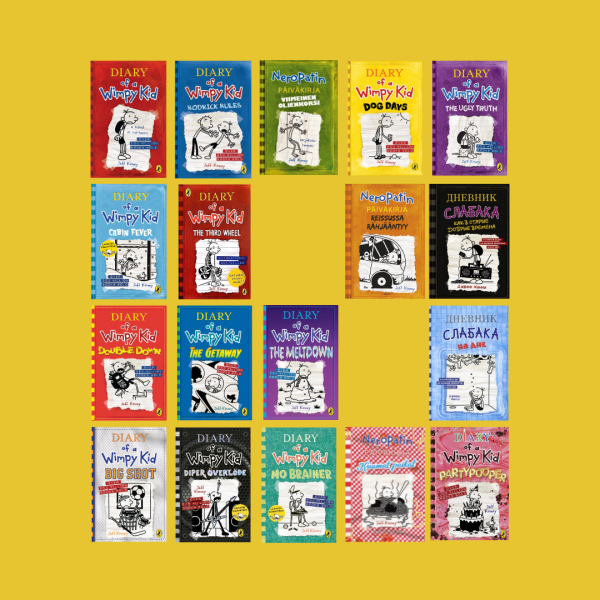
Here is the list of Diary of a Wimpy Kid books I’ve read so far:
- Дневник слабака. 🇷🇺 (Diary of a Wimpy Kid (2007))
- Diary of a Wimpy Kid: Rodrick Rules (2008) 🇬🇧
- Neropatin päiväkirja: Viimeinen oljenkorsi. 🇫🇮 (Diary of a Wimpy Kid: The Last Straw (2009))
- Diary of a Wimpy Kid: Dog Days 🇬🇧 (2009)
- Diary of a Wimpy Kid: The Ugly Truth (2010) 🇬🇧
- Diary of a Wimpy Kid: Cabin Fever (2011) 🇬🇧
- Diary of a Wimpy Kid: The Third Wheel (2012) 🇬🇧
- Neropatin päiväkirja: reissussa rähjääntyy. 🇫🇮 Diary of a Wimpy Kid: The Long Haul (2014)
- Дневник слабака. Как в старые добрые времена. 🇷🇺 (Diary of a Wimpy Kid: Old School (2015))
- Diary of a Wimpy Kid: Double Down (2016) 🇬🇧
- Diary of a Wimpy Kid: The Getaway (2017) 🇬🇧
- Diary of a Wimpy Kid: The Meltdown (2018) 🇬🇧
- Diary of a Wimpy Kid: Wrecking Ball (2019) 🇬🇧
- Дневник слабака. На дне. 🇷🇺 ( Diary of a Wimpy Kid: The Deep End (2020))
- Diary of a Wimpy Kid: Big Shot (2021)
- Diary of a Wimpy Kid: Diper Överlöde (2022)🇬🇧
- Diary of a Wimpy Kid: No Brainer 🇬🇧 (2023)
- Neropatin päiväkirja: Kuumat paikat 🇫🇮 (2024)
- Diary of a Wimpy Kid: Partypooper (2025) 🇬🇧
Related posts:
No related posts.